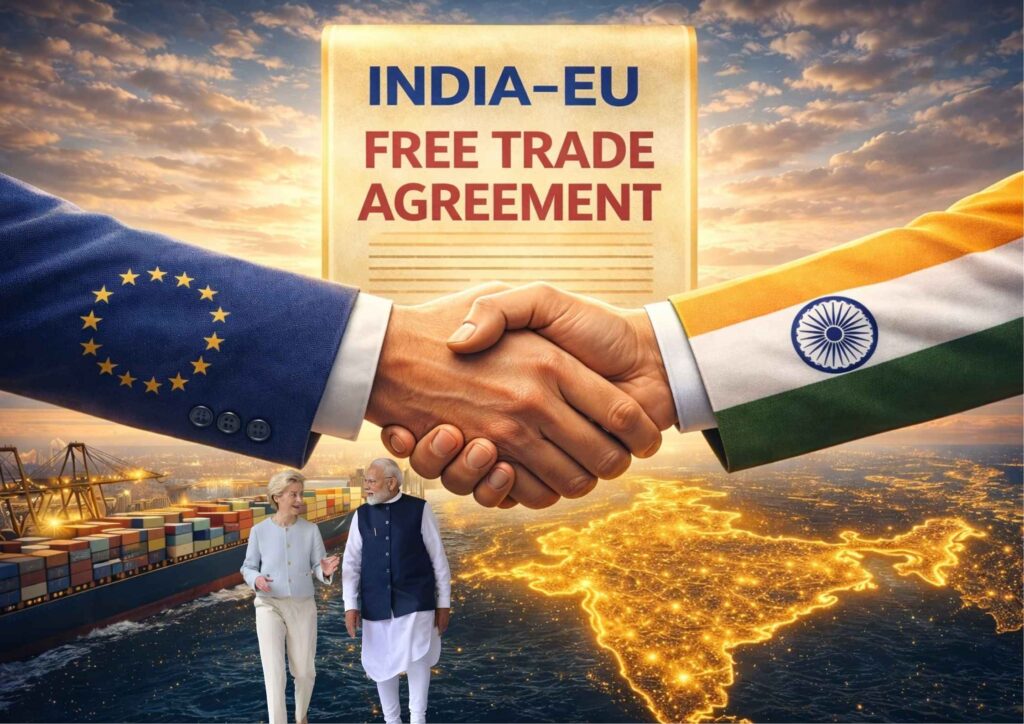
India and the European Union have finally concluded negotiations politically, a long-awaited Free Trade Agreement—and this is not just another trade headline. This deal quietly reshapes India’s economic future at a time when global trade is fragmenting, supply chains are moving, and jobs are at stake.
For Indian businesses, exporters, startups, and policymakers, this agreement opens doors that were shut for decades. But it also brings tough competition and new rules. Miss the signal now, and the cost could be huge.
What’s Happening With the India–EU FTA?
India and the EU have concluded a comprehensive Free Trade Agreement. Most FTAs focus narrowly on reducing import duties. The India–EU FTA goes much further.
It covers: Goods and services, Investment protection, Digital trade and data flows, Intellectual property rights, Government procurement, Supply-chain resilience, Defence cooperation, Sustainability and climate standards
The EU is India’s largest trading partner, with bilateral trade in goods only crossing $137 billion annually(2023- 2024 data) in recent years. The FTA aims to push this figure sharply higher by removing tariffs, reducing regulatory barriers, and improving market access on both sides. In short, this deal is about how India integrates into global value chains for the next 20–30 years, not just about cheaper exports but long-term economic positioning also.
Why the India–EU FTA Matters for India’s Economy and Trade ?
Global trade is no longer stable or predictable.
- US–China tensions remain unresolved
- Europe is reducing dependence on China
- Companies are shifting supply chains away from single-country risk
In this environment, the India–EU FTA positions India as a China-plus-one manufacturing and services hub. For Europe, it offers access to one of the world’s fastest-growing major economies. For India, it is strategic leverage. Together India-European Union represent: ~2 billion people, ~25% global GDP, ~30% of global trade, a massive economic scale. Unlike past trade agreements, the India–EU FTA links trade access with climate rules, digital standards, and supply-chain security—making it a next-generation deal.
According to India’s Ministry of Commerce and the European Commission, the EU accounts for nearly 17% of India’s total exports, making it a critical long-term market. Industry estimates suggest that India’s exports to the EU could grow 30–40% over the next decade if businesses adapt quickly.
Why India–EU FTA Geopolitically Significant ?
For Europe:
- Reduce overreliance on USA
- Reduce dependency on China
- Creates a non- NATO strategic pillar
- Expand EU presence in Indo-Pacific region
- Revive Europe’s Economy
- Strengthens multipolarity
- Encourages rule-based democratic alliances
- Creates a gap between India & Russia, “May gradually rebalance India’s economic partnerships, without directly altering strategic alliances.”
For India:
- It strengthens India’s strategic autonomy
- It diversifies trade away from overdependence on any one bloc
- It aligns India with rule-based, high-standard global trade
- Helps maintain India’s status as fastest growing economy of world
- Protects Indian exporters from sudden tariff shocks and protectionist waves.
At a time when protectionism is rising, India has chosen deeper integration—but on negotiated terms.
⚠️ Warning Signal: Countries that fail to integrate into new trade blocs risk being sidelined in global supply chains.
Impact on India: Business, Jobs, and Policy
1. Manufacturing Gets a Boost
Sectors expected to gain the most include:
- Auto components
- Engineering goods
- Electronics and machinery
- Industrial chemicals
- Pharmaceuticals & medical devices
- Textiles, leather & footwear sector
Lower tariffs and predictable EU access make India more attractive for global manufacturing investments. This directly supports India’s goal of becoming a manufacturing powerhouse.
2. Services and IT See Faster Growth
The EU is already one of India’s largest markets for IT and professional services. Easier mobility, clearer regulations, and digital trade rules can accelerate growth.
3. Job Creation Potential
Export-led growth typically generates more jobs. Analysts suggest that trade expansion with the EU could support millions of direct and indirect jobs over time, especially in MSMEs.
Opportunities Indian Businesses Should Not Ignore
- Preferential access to a 450+ million consumer market
- Easier entry for Indian MSMEs into Europe
- Joint ventures with European firms in green tech and manufacturing
- Better access to capital, technology, and design expertise
- Stronger position in global value chains
Smart companies will move before competitors do.
The Risk Side: What Can Go Wrong
Every big trade deal creates winners—and losers.
Key Risks
- Increased competition for domestic players
- Pressure on sensitive sectors like dairy and alcohol
- Higher compliance costs due to EU climate and ESG rules
- Risk of Indian firms being unprepared for strict standards
⚠️ Warning Signal: Companies that fail to upgrade quality and sustainability standards may lose market share at home and abroad.
Climate and Sustainability: Europe’s Red Line
The EU insists on strong climate commitments in modern trade deals.
For Indian exporters, this means:
- Carbon reporting requirements
- Cleaner manufacturing processes
- Compliance with future carbon border taxes
While this raises costs in the short term, it also pushes Indian industry up the value chain.
📌 Key Insight: Green compliance is no longer optional—it’s a market entry ticket.
What Smart Businesses and Investors Should Do Now
- Map EU demand for your products or services
- Invest in quality, certification, and sustainability
- Rework supply chains to meet rules-of-origin norms
- Explore partnerships with European companies
- Track policy notifications and implementation timelines
Those who prepare early will dominate later. “Miss the signal now, and the cost could be huge.“
Key Takeaways
- The India–EU FTA is a long-term strategic deal, not a short-term trade boost
- It strengthens India’s position in global supply chains
- Manufacturing, IT, and MSMEs stand to gain the most
- Climate and compliance standards will separate winners from losers
- Early movers will capture the biggest benefits
Finally: A Deal That Rewards Preparation
The India–EU FTA will not automatically make everyone a winner. It rewards preparation, scale, and strategic thinking.
For India, this deal is about shaping the next 20 years of growth. For businesses, it is a clear signal: adapt fast or fall behind.
If you want clear, India-focused analysis on geopolitics, technology, and business impact—subscribe to BharatTechBusiness and stay ahead of the curve.
You might like this also: AI at Full Speed: Progress or Perish? World’s Toughest Debate, No Nation Can Escape
FAQs
1. What is the India–EU FTA?
It is a comprehensive free trade agreement covering goods, services, investment, and sustainability between India and the European Union.
2. Why is it called the “mother of all trade deals”?
Because of its scale, complexity, and long-term impact on India’s economy and global positioning.
3. Which sectors benefit most?
Manufacturing, auto components, engineering goods, IT services, pharmaceuticals, and MSMEs.
4. Are there risks for Indian businesses?
Yes. Increased competition and strict EU standards may pressure unprepared firms.
5. Will this create jobs in India?
Export growth and new investments are expected to support significant job creation over time.
6. When will businesses feel the impact?
Gradually, as implementation phases roll out over the next few years.