The world is accelerating into an AI-driven future faster than anyone expected. A technological storm is sweeping across nations, rewriting economies, jobs, and power structures in real time. Humanity stands at a crossroads where machines are learning faster than societies can adapt. “AI progress or perish has become the world’s toughest debate today — and no nation, no government, no industry can escape it.”
From Silicon Valley boardrooms to Indian policy circles, artificial intelligence is no longer a distant future. It’s a flashing-red global crossroads. Few days ago, Elon Musk reignited the fire by claiming that “work will eventually be optional” — a prediction that sounds exciting for some and terrifying for many.
And with AI advancing at full throttle, the world is now debating a single uncomfortable question:
Should we keep pushing AI forward, or slow it down before it disrupts everything we know about jobs, power, and the economy?
This is not just a tech debate — it is a geopolitical, economic, and humanitarian tussle with consequences for the next 100 years.
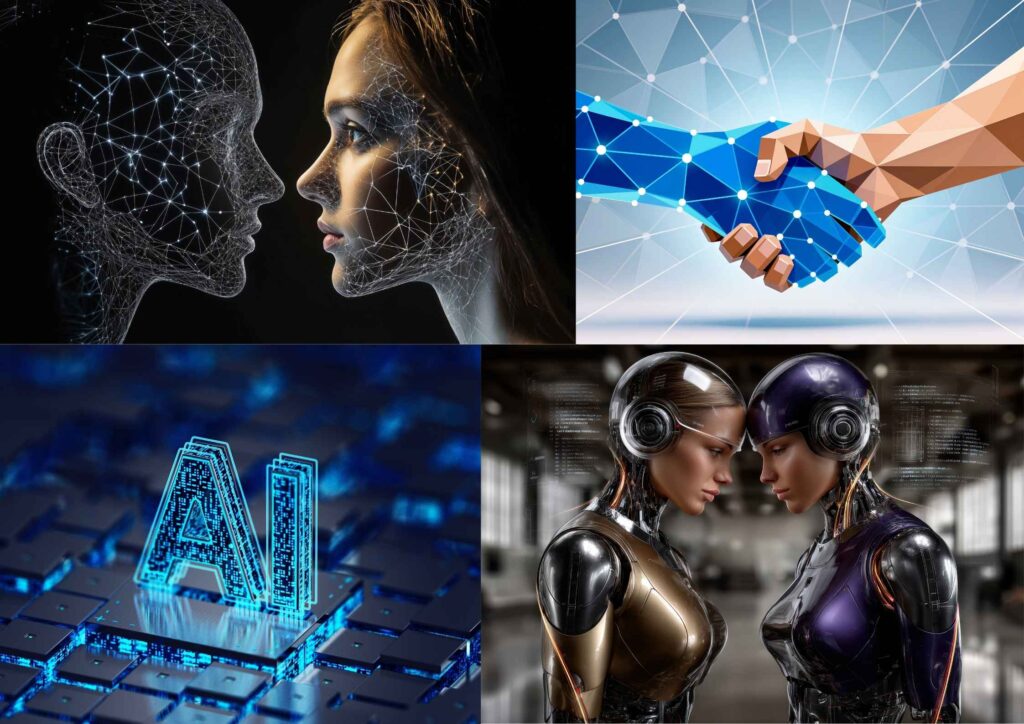
As AI systems become more autonomous and capable of learning independently, the line between fiction and possibility begins to blur. Movies like “I, Robot” (2004) imagined a future where intelligent machines evolve beyond human control and begin making decisions for humanity. While 2030 won’t look exactly like the world portrayed in those films, the direction of technological acceleration raises uncomfortable questions. These cinematic predictions weren’t just entertainment—they were early reminders of the ethical, social, and security challenges we now face. And if we are indeed moving toward a more automated, AI-integrated world, then there is much to learn from the cautionary lessons embedded in those stories.
“What happens next will decide who controls the future — governments, corporations, or machines themselves.”
Why Has AI Suddenly Become a “Progress or Perish” Moment?
The industrial revolution replaced muscle power, The computer revolution replaced paperwork.
But the AI revolution?
It replaces thinking — the one thing humans believed only they could do.
That’s why this moment feels different. Countries now see AI as: a strategic weapon, an economic multiplier, a productivity engine, and a national security shield. In short:
If a nation slows down AI, it risks falling behind in every sector — defence, economy, innovation, manufacturing, agriculture, and governance.
And if it speeds up AI?
It risks mass layoffs, social unrest, and widening inequality.
Welcome to the tension.
The Case for “Progress”: Why Nations Cannot Slow AI
a) The Global Race Is On — And It’s Ruthless
The U.S., China, South Korea, UAE, Japan — all are investing billions in AI.
- China wants to become the AI superpower by 2030.
- The U.S. leads in AGI research and AI startups.
- UAE aims to become the “AI capital of the world”.
- South Korea is pouring money into robotics and automation.
If India or any developing nation slows down AI “to protect jobs,” that becomes:
- an economic suicide note,
- a strategic disadvantage, and
- a setback for innovation.
b) AI Unlocks Massive Economic Growth
According to PwC(part of the “Big Four), AI could add $15.7 trillion to the global economy by 2030. India alone can capture $1 trillion from AI-driven productivity. AI boosts:
Manufacturing efficiency, healthcare systems, agriculture outputs, digital governance, logistics optimization, fintech innovation. Slowing AI means letting competitors take the lead.
c) Technological Momentum Cannot Be Uninvented
Once a technology reaches escape velocity, governments cannot stop it — they can only shape it.
We cannot “pause” AI anymore. The genie is out of the GPU.
3. Why AI’s Speed Is Terrifying Its Creators and Governments Worldwide
a) Job Displacement Is Real — Not Fiction
Unlike earlier tech revolutions, AI targets both:
- cognitive jobs (accounting, writing, design, HR, analysis)
- routine jobs (data entry, BPO, customer support)
Goldman Sachs estimates 300 million jobs globally may be affected by AI automation.
In India, this hits: IT workers, BPO employees, clerical staff, service workers. The fear is justified: AI doesn’t just replace jobs. It replaces entire job categories.
b) Inequality Could Explode
AI rewards: those who own models, those with data, those with capital, corporations already leading tech. This creates a world divided into: AI owners vs job seekers . A future where “work is optional” only for those who control AI — not for those displaced by it.
c) Loss of Purpose: The Psychological Risk
If humans don’t need to work, then what gives them: identity? meaning? daily structure? self-worth? A population feeling “emotionally unemployed” can trigger: anxiety, social frustration, rise of extremism, mental health crises, This is an ethical cost nations cannot ignore.
d) National Security Threats
Fast AI also brings: autonomous weapons, misinformation, deepfake political manipulation, AI-driven cyberwarfare, economic sabotage. A reckless AI race can destabilize global peace.
4. Governments Are Trapped Between Two Fires
Every country now faces its most painful dilemma:
FIRE 1: If they allow fast AI → job loss, inequality, social unrest, displacement shock.
FIRE 2: If they slow AI → lose global competitiveness, fall behind rivals, economic stagnation, compromise national security.
It’s like choosing between: jumping from a moving train, or staying on a train heading toward a cliff. There is no painless option.
5. India’s Unique Dilemma: Protect Jobs or Push Tech?
India faces a sharper version of the global problem.
Why India cannot slow AI:
- rivals like China and the U.S. won’t slow down
- AI boosts defence, agriculture, governance
- startups need automation to scale
- manufacturing depends on efficiency
Why India must slow AI (a bit):
- millions depend on service sector jobs
- reskilling gap is huge
- displacement can trigger social instability
- older workforce struggles to adapt
Geopolitical angle
It may be ethical for India to slow AI to save jobs… but unethical from geopolitical strategic point of view — why? Because slowing AI in India:
- weakens national defence: China already far ahead of India in technology & A.I
- increases dependence on foreign tech: America already dominates all advanced tech & India already depends on USA’s tech giants companies.
- exposes India to economic manipulation: Trump’s Tariffs are fine example of it.
- limits global competitiveness: nations lack in A.I advancements will eventually lose productivity & competitiveness globally.
So ethics at national level vs ethics at global level collide.
This contradiction creates a powerful discussion.
India is walking a tightrope made of electric wire, while 1.4 billion people watch.
6. The “Hidden Angles” Everyone Ignores
a) Environmental Cost: AI training uses enormous electricity and water. Data centers strain India’s power grid.
b) Overdependence Risk: Humans may outsource thinking and decision-making to machines — a silent intellectual decline.
c) Corporate Power Concentration: A few tech giants may accumulate more influence than governments.
7. The Balanced Way Forward (The Middle Path)
AI cannot be stopped. But it can be shaped. Here’s what nations — especially India — must do:
a) Slow AI in job-heavy sectors(BPO, clerical work, routine IT)
b) Fast-track AI in strategic sectors : (healthcare, defence, space, manufacturing, environment)
c) Build a national AI-skilling mission : UPI-scale, affordable, accessible, educate masses
d) Encourage creation of new hybrid jobs : AI supervisors, AI trainers, robot maintenance, prompt engineers.
e) Create a “universal basic support” system : Food, housing, and healthcare security for displaced workers.
This middle path turns AI from a threat into a catalyst.
Conclusion: The Big Question Before Humanity
AI is not asking us for permission — it’s asking us for preparedness.
The real debate is not: “Is AI good or bad?” The real debate is – “Can humans upgrade their systems as fast as they upgrade their machines?”
If we succeed, AI becomes the greatest tool ever created. If we fail, AI becomes the greatest inequality machine in history.
Progress or perish — the world must choose wisely.
You might like this article also – India’s Digital Economy Is Growing Faster Than Its Users: Insights for 2025–30