India is entering a defining phase of its economic transformation — a phase where digital infrastructure is advancing faster than user adoption. The latest insights from the State of India’s Digital Economy Report 2025 show that while India ranks among the world’s most digitally equipped nations, everyday digital consumption and spending per user remain relatively low.
This widening gap between digital capability and digital usage presents one of the biggest opportunities — and strategic challenges — for businesses in 2025–30.the next phase of growth will depend on how fast citizens, businesses, and industries convert digital access into digital value creation.
To understand what this means, we must first understand the digital economy itself, the CHIPS framework used to measure it, and the structural forces shaping India’s next digital leap.
What Is the Digital Economy?
The digital economy refers to all economic activities that are enabled, powered or accelerated by digital technologies, such as:
- Internet and mobile connectivity
- Digital payments and fintech
- Online commerce and platforms
- Cloud computing, AI and automation
- Data & Digital public infrastructure (UPI, Aadhaar, ONDC, DigiLocker etc.)
In simple words:
The digital economy is the part of economy that runs on digital data, internet connectivity, online commerce platforms, digital services and technology create value — instead of only physical products or manual processes.
Three Components of the Digital Economy
| Component | Meaning | Examples |
|---|---|---|
| Digital Infrastructure | The backbone that enables digital activity | Internet, 5G, cloud, data centers |
| Digital Platforms & Services | Systems people and businesses use | UPI, ONDC, OTT, fintech apps, e-commerce |
| Digital Adoption Across Sectors | Traditional industries going digital | Telemedicine, e-learning, online banking, industry 4.0 |
India’s Digital Economy Outpaces Its Users
According to the latest assessment from the State of India’s Digital Economy 2025( by ICRIER ) :
- India ranks 3rd globally in economy-wide digitalisation.
- But ranks 28th in user- level digital consumption.
This means India has already built the digital highway — but traffic is still catching up.
So, how do we measure this imbalance scientifically?
The answer lies in the CHIPS framework.
Understanding the CHIPS Framework (ICRIER)
To track India’s digital progress, ICRIER(SIDE Report 2025) uses the CHIPS framework — a comprehensive method to measure digital capacity and digital usage.
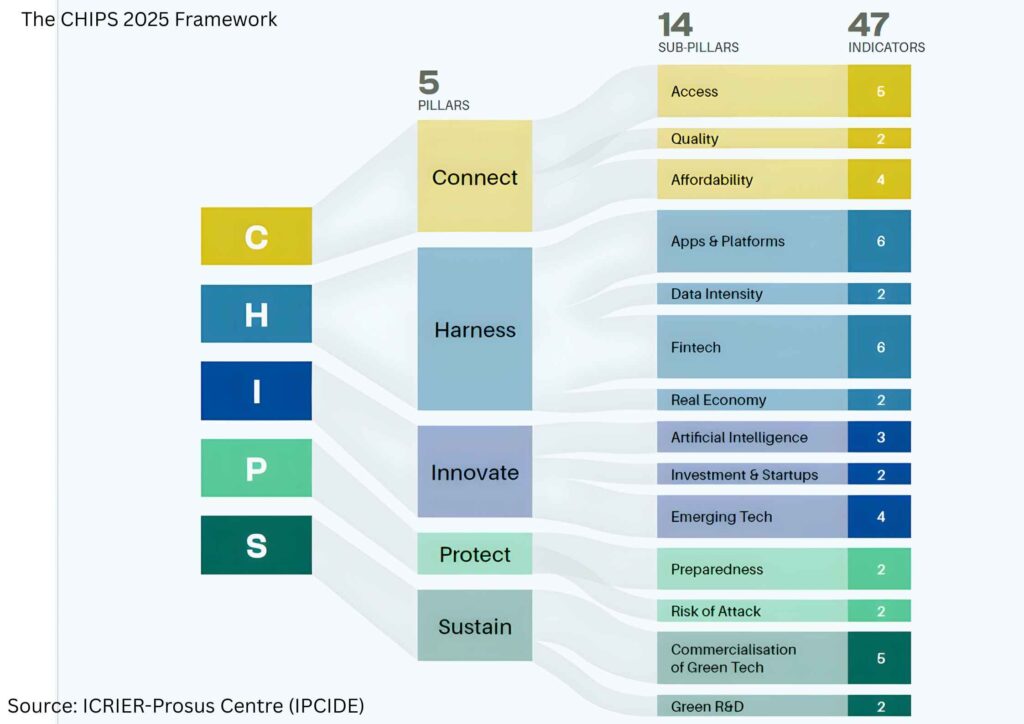
| CHIPS Pillar | Meaning | India’s Standing | Insight |
|---|---|---|---|
| Connect | smartphone penetration, Internet access & affordability | Rank 18 | Connectivity improving but rural access + quality still need work. |
| Harness | Economy Harnesses digital technologies – ICT services, digital public infrastructure, fintech, platforms. | Rank 3 | India excels in UPI, Aadhaar, IT exports — strong digital foundation. |
| Innovate | AI, startups, emerging tech & R&D | Rank 9 | Startup ecosystem is strong; AI research capacity must scale. |
| Protect | Cybersecurity & risk resilience | ↓ Part of Rank 25 | Cyber readiness remains weak — needs urgent strengthening. |
| Sustain | Green tech, energy-efficient digital growth | ↓ Part of Rank 25 | Digital growth must become more environmentally sustainable. |
Key Findings From the State of India’s Digital Economy Report 2025
1. Digital GDP Share Rising Fast = ~11.74% of national income (2022–23)
And projected to reach ~20% by 2029–30.
2. Digital economy growing nearly 2× faster than the overall economy
3. Platforms are the fastest-growing segment
E-commerce, mobility apps, ONDC-layer services, fintech, creator economy.
4. Digital workers are 5× more productive
But they still form only around 2.5% of the workforce– showing untapped potential
5. Tier-2 & Tier-3 cities are now digital hotspots
Digital adoption outside metros & capital cities is accelerating sharply, strong adoption has been noticed at pan india.
6. India’s digital public infrastructure (DPI) is unmatched globally
UPI → payments revolution
Aadhaar → identity backbone
ONDC → open commerce
ABDM → digital health (Ayushman Bharat Digital Mission) Almost every service in public sector has been working in digital mode, government emphasises on paperless service.
7. User-level spending is low
Indicating potential for explosive growth in paid digital services.
Why Is India’s Digital Economy Growing Faster Than Its Users? (Root Causes)
1. Rapid supply-side expansion
- Cheap data
- 4G/5G access
- Strong government digital infrastructure
- Massive startup ecosystem
2. Low digital spending power
Users access digital platforms, but rarely pay premium prices.
3. Digital literacy gaps
Especially rural & elderly populations.
4. Affordability gap
Digital services remain unaffordable for a large section of society.
5. Trust and safety concerns
Users still hesitate in digital finance, data sharing.
What This Means for Businesses (2025–30)
1. Biggest growth opportunities lie in Tier-2 & Tier-3 India
User adoption is accelerating fastest outside metros.
2. Freemium → Paid conversion is the next goldmine
OTT, fintech, SaaS, edtech, healthtech — all will grow when users shift from free usage to paid value.
3. Platform economy will dominate the market
Businesses must integrate with:
- ONDC
- UPI ecosystem
- Aadhaar-enabled services
- Account Aggregator (AA framework)
4. AI + Data + Digital Public Infrastructure = New business models
Expect new services on top of:
- Credit on UPI
- AI-based MSME tools
- Digital health records
- Data-sharing frameworks
5. Cybersecurity & trust will become business differentiators
The winners will be trusted digital brands.
6. Digital-first businesses gain advantage over traditional-only models
Roadmap to 2030: What Businesses Should Do Now
1. Build for the Bharat market
Local languages, affordability, simplicity will win.
2. Monetise the digital adoption gap
Early users → paid users → loyal ecosystem customers.
3. Integrate with India’s public digital rails
UPI, ONDC, eKYC, AA — these are accelerators.
4. Invest in digital skilling
Digital workforce = high productivity + lower cost. Prepare for AI-integrated workflows and digital-skilled hiring
5. Use AI, automation, and cloud to scale cheaply
Especially for MSMEs and startups.
6. EdTech (No more only videos)
EdTech won’t just be content — it will be AI-driven adaptive learning + job-linked training. AI-personalized education paths. Google NotebookLM is nice example to simplify learning, now what else could be done to make education more affordable, interactive and capable to solve all curriculums doubts.
The digital economy is expanding. The user economy must follow. Businesses that bridge this gap will own the next decade.
Conclusion
India has built one of the world’s strongest digital economic foundations — but the next phase depends on how deeply users engage with that digital infrastructure. As the digital economy grows nearly twice as fast as user adoption, the gap itself becomes a huge business opportunity.
For companies operating in India between 2025 and 2030, the winning strategy is clear:
Build for digital India, but design for the Indian user.
The gap between both is where the next decade’s growth lies.
“You may find this useful: Semiconductor chips & critical minerals strategic to India’s economy & AI future.