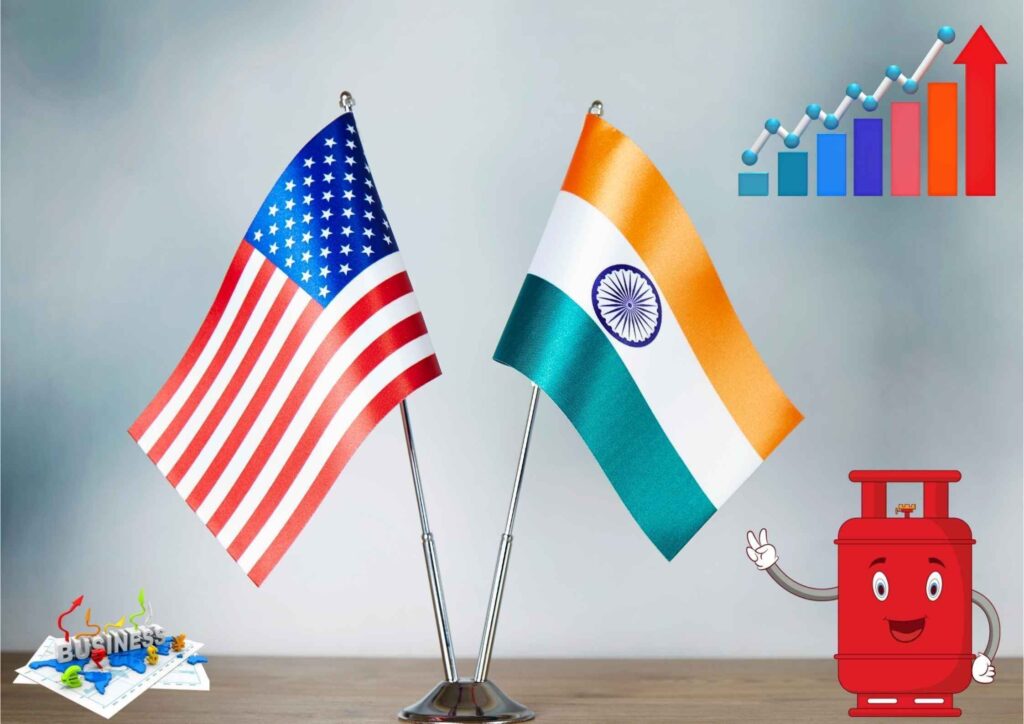
India’s first structured long-term LPG import agreement with the United States marks a powerful strategic milestone in the evolving India–US economic partnership. Beginning 2026, India will import nearly 10% of its LPG from the U.S., signalling a decisive shift in energy sourcing, supply-chain strategy, and geopolitical alignment. More than a fuel contract, the India–US LPG deal represents a strategic shift in how India secures its energy needs, reduces regional vulnerabilities, and strengthens future trade partnerships with the world’s most influential economy.
Strengthening India–US Ties: A New Geopolitical Pathway
The LPG agreement comes at a time when both nations are consciously moving closer through energy, trade, and strategic cooperation. India has begun reducing its dependence on discounted Russian oil, while steadily increasing crude, LNG, and LPG imports from the United States. This recalibration not only diversifies India’s energy basket but also solidifies U.S. confidence in India as a long-term strategic partner.
For Washington, the shift helps rebalance bilateral trade, where the U.S. aims to expand energy exports, while India seeks more equitable market access, making both sides strategically invested.. The LPG deal, therefore, creates a win-win: the U.S. gains a growing energy market, and India strengthens a stable partnership with a country that offers security, technology, investment, and global influence. This strategic energy alignment lays the groundwork for deeper trade agreements, boosts India’s negotiating leverage in future trade talks, supply-chain partnerships, and long-term diplomatic cooperation.
Why the India–US LPG Deal Is a Strategic Shift
1. Energy diversification and security
India has historically depended heavily on Middle Eastern LPG suppliers. By sourcing 10% of its LPG from the U.S., India makes a significant strategic shift toward multi-regional energy stability. This diversification reduces vulnerability to geopolitical risks, shipping disruptions, and regional conflicts, strengthening India’s long-term energy security.
2. Rebalancing global energy relations
The shift toward U.S. LPG sends a message that India intends to broaden partnerships beyond its traditional suppliers. This doesn’t replace Middle East ties—it strengthens India’s bargaining power across all supplier nations, giving it more flexibility in pricing, logistics, and long-term deals.
3. Competitive pricing and new benchmark advantages
The deal uses the Mont Belvieu benchmark instead of the traditional Middle East pricing formula. This creates competitive tension in global markets and introduces new pricing mechanisms for Indian refiners. Over time, diversified benchmarks can help India negotiate better terms across all energy imports.
Business Impact: Implications for Indian Industries
The India–US LPG deal carries strong business implications across India’s energy ecosystem. State oil companies like IOC, BPCL, and HPCL benefit from a more predictable import structure, less exposure to regional volatility, and better risk management across supply chains. Longer-haul U.S. shipments will boost India’s logistics, port infrastructure, and maritime operations—driving upgrades in storage capacity, handling systems, and cargo automation technologies.
The petrochemical sector gains a significant advantage because U.S. LPG contains a higher propane ratio, offering an efficient feedstock for chemicals, plastics, and advanced material production. With India aiming to increase domestic manufacturing, the availability of propane-rich LPG strengthens downstream industries.
Technology also becomes a key enabler. The shift encourages adoption of digital supply-chain tools, IoT-based cylinder tracking, AI-led demand forecasting, and analytics-driven blending optimization. These advancements improve efficiency, transparency, and safety across India’s LPG network.
Short-Term Impact: Supply Chain Adjustments and Stability
In the short term, India’s oil marketing companies will undergo a transition period as they integrate U.S. LPG into existing infrastructure. Longer supply routes from the U.S. Gulf Coast require adjustments in logistics planning, port readiness, and inventory management. Some refiners may need to adapt blending processes for the propane-heavy U.S. mix.
However, India immediately gains from reduced geopolitical risk, as reliance on a single region declines. The deal supports consistent LPG availability for domestic households, distributors, and industrial users. It also encourages ports and terminals to upgrade storage tanks, safety systems, and digital monitoring solutions—creating momentum for modernization.
Long-Term Impact: A Stronger Energy and Trade Framework
Over the long term, this deal strengthens India’s strategic energy stability and positions the country as a multi-sourced, globally integrated energy consumer. It enhances India’s leverage with all future suppliers, improves global trade competitiveness, and supports India’s transition to a more resilient energy supply chain.
The partnership also unlocks opportunities in future bilateral deals—including LNG supply, renewable energy cooperation, digital supply-chain systems, critical minerals, and advanced technology transfers. With the U.S. aiming to expand its Indo-Pacific influence and India seeking greater global integration, the LPG deal becomes a building block for larger economic, technological, and geoeconomic frameworks.
India’s downstream industries—manufacturing, petrochemicals, logistics, ports, and equipment suppliers—stand to benefit significantly from consistent supply, stronger pricing power, and modernized infrastructure. Over time, these advantages contribute to India’s broader economic growth story.
Summary
The India–US LPG Deal is more than an energy agreement—it is a strategic shift shaping the future of bilateral trade partnerships. It strengthens India’s energy security, deepens trade relations with the United States, and fuels new opportunities for businesses across logistics, petrochemicals, technology, and manufacturing. As India expands U.S. energy imports and balances geopolitical relations, the deal becomes a cornerstone for future cooperation across sectors.
For India, this marks a step toward resilient energy strategies and diversified global partnerships. For the United States, it strengthens presence in one of the world’s fastest-growing energy markets. For both, it is a strategic, stable, and forward-looking win.